Want to build an API that AI agents can use and eventually pay for? Download our free Python and FastAPI starter kit and learn how to create a usage-metered research service with persistent jobs, authentication, credits, and automated processing.
Published: October 24, 2026
Category: Free AI Agent Starter Kits
Difficulty: Intermediate
Technologies: Python, FastAPI, SQLite, REST APIs, JSON
License: MIT
Price: Free
Introduction: Turn an AI Research Capability into a Software Product
Most AI developers begin by building applications for human users.
They create chatbots, research assistants, automation workflows, and AI-powered productivity tools.
But a new opportunity is emerging.
What if the customers using your software are other AI agents?
Imagine a sales assistant that needs information about a potential customer.
The assistant could call a specialized research API, request a company report, and receive structured information.
Or imagine a procurement agent that needs industry intelligence before preparing a supplier recommendation.
Instead of researching everything itself, the agent could use an external service.
That service might charge for each successful research operation.
This is one possible business model within the emerging AI agent economy.
For developers, it offers an interesting alternative to building a traditional SaaS application with a complex frontend.
You can begin with a focused API that performs one valuable task.
Later, you can add commercial access controls, customer accounts, usage-based pricing, and agent-compatible payments.
To help developers explore this approach, we created the Free Paid AI Research API Starter Kit.
It is a downloadable Python project that demonstrates the foundations of a usage-metered research service.
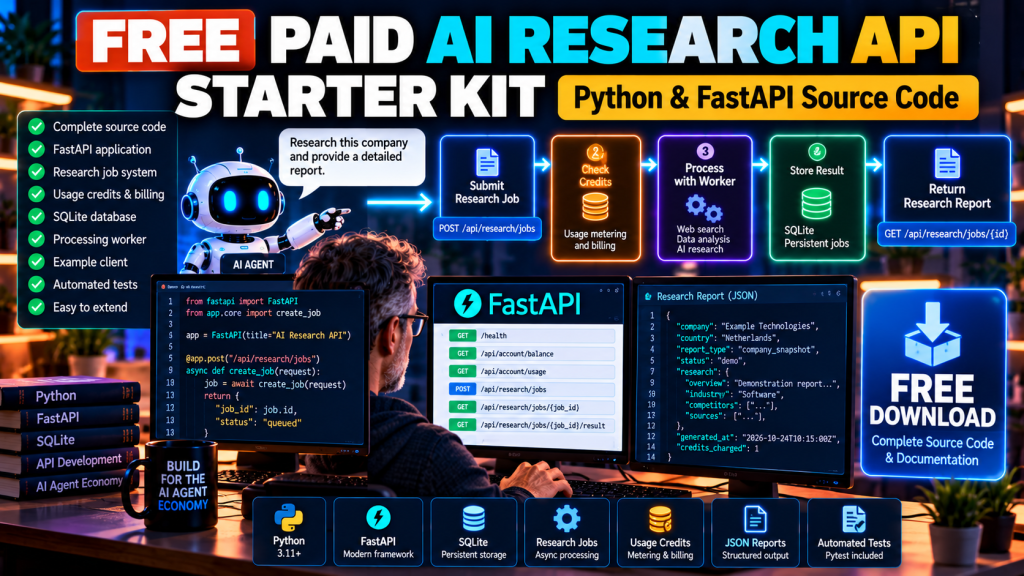
The kit includes an API, persistent research jobs, simulated credits, a separate worker, an example client, and automated tests.
You can run everything locally.
No credit card, paid API subscription, cryptocurrency wallet, or payment gateway is required.
The starter kit is intended for learning and experimentation. It does not perform live research or collect actual payments.
1. Download the Free Paid AI Research API Starter Kit
Download the complete starter kit for free:
Download Free Paid AI Research API Starter Kit — ZIP File
The ZIP archive includes the Python source code, project configuration, example client, test suite, and installation instructions.
It is released under the MIT License, allowing developers to study, modify, and reuse the code under the terms of that license.
What you receive
- Complete FastAPI application.
- Persistent SQLite database support.
- API-key authentication for local development.
- Research job submission and status tracking.
- Five initial demonstration credits.
- Credit reservation and consumption logic.
- Separate research-processing worker.
- Idempotency protection against duplicate submissions.
- Usage reporting endpoint.
- Python example client.
- Automated API tests.
- Installation and setup instructions.
- MIT License.
Important: The credits are simulated and have no monetary value. The kit demonstrates the architecture of a paid-access API but does not include real financial settlement or live AI research.
That distinction allows developers to explore the commercial architecture safely before adding external services.
2. What Can You Build with This Starter Kit?
The starter kit provides a foundation for experimenting with API-based software businesses.
The demonstration application accepts structured research requests.
For example, a client can submit:
{ "company": "Example Technologies", "country": "Netherlands"}
The application creates a research job and stores it in SQLite.
A separate worker processes the request.
Once the job is completed, the API returns a structured JSON report.
The demonstration report explicitly identifies itself as sample data.
A future version could integrate real company-information sources and AI-assisted analysis.
Potential applications
You could adapt this architecture to build:
Company research APIs: Retrieve and analyze company information.
Competitor intelligence services: Generate structured competitor comparisons.
Industry analysis APIs: Produce specialized reports for particular markets.
Supplier research tools: Provide information for procurement workflows.
Document processing services: Analyze documents and return structured results.
Agent-native micro-SaaS products: Expose useful operations to other applications through APIs.
The starter kit does not implement all these applications.
Instead, it provides reusable architectural components that can support their development.
3. How Does the Research API Work?
The project demonstrates a job-based processing architecture.
A typical workflow follows six stages.
Step 1: Submit a research request
A client sends an HTTP POST request to the API.
The request includes an API key, an idempotency identifier, and structured research parameters.
Step 2: Check available credits
The application verifies the configured development credentials and checks the account’s demonstration credit balance.
Each new accepted research job requires one credit.
Step 3: Create a persistent job
The application stores a job record in SQLite.
The initial status is queued.
One credit is reserved from the available balance.
Step 4: Process the research job
A separate Python worker retrieves one queued job and processes it.
In the starter kit, this processing generates a demonstration report.
Step 5: Record completion and usage
When processing succeeds, the application stores the completed report and records the consumed credit.
If processing encounters a handled failure, the demonstration releases the reserved credit.
Step 6: Retrieve the report
The client queries the API using the job identifier.
Once the job is complete, the API returns the structured report.
The result can be consumed by a Python application, an AI-agent workflow, or another compatible software system.
This separation between job submission and job execution is useful for research tasks that may take longer than an ordinary HTTP request.
4. The Technology Behind the Starter Kit
The project uses a deliberately small technology stack.
Python
Python provides the application logic, background processing, and integration capabilities.
It is widely used in AI development and supports numerous libraries for APIs, databases, and data processing.
FastAPI
FastAPI provides the REST API.
It supports structured request validation, typed parameters, JSON responses, and automatic API documentation.
After starting the application, developers can access the interactive documentation at:
http://127.0.0.1:8000/docs
SQLite
SQLite stores accounts, job information, credit balances, and usage records.
It requires no separate database server, making local setup straightforward.
For production applications with multiple customers and workers, PostgreSQL may be a better choice.
Separate Python worker
The processing worker runs independently of the API server.
It processes one queued job per execution.
This makes the demonstration easy to inspect and test.
A production implementation would normally use a continuously running worker with durable queueing and failure recovery.
JSON
All API results use structured JSON.
This makes the service suitable for programmatic consumption.
AI agents can work with structured data more reliably than with arbitrary HTML pages or manually formatted reports.
5. What’s Inside the Download?
The package includes the following project structure.
paid-ai-research-api-starter-kit/│├── app/│ ├── __init__.py│ ├── core.py│ ├── main.py│ └── worker.py│├── examples/│ └── client.py│├── tests/│ └── test_api.py│├── requirements.txt├── .env.example├── .gitignore├── README.md└── LICENSE
Each file serves a specific purpose.
app/main.py: Defines the FastAPI endpoints.
app/core.py: Contains the SQLite persistence, credit accounting, and job-processing logic.
app/worker.py: Executes one queued job.
examples/client.py: Demonstrates how a Python application can submit requests to the API.
tests/test_api.py: Contains automated tests for important application behavior.
requirements.txt: Lists the Python dependencies.
.env.example: Provides example environment configuration.
README.md: Explains how to install, configure, run, and test the application.
LICENSE: Contains the MIT License.
The project structure is small enough for developers to understand while still demonstrating several important backend concepts.
6. Step-by-Step Installation
Getting started requires Python 3.11 or newer.
You will also need a code editor and a terminal.
Step 1: Download and extract the project
Download the ZIP file from the link above.
Extract it into a local development folder.
Open the extracted project in Visual Studio Code or your preferred editor.
Step 2: Create a virtual environment
On Windows PowerShell:
py -m venv .venv.venv\Scripts\Activate.ps1
On Linux or macOS:
python3 -m venv .venvsource .venv/bin/activate
Step 3: Install the dependencies
Run:
pip install -r requirements.txt
This installs the packages required by the application and its tests.
Step 4: Configure the demonstration API key
In Windows PowerShell:
$env:DEMO_API_KEY="local-development-only-secret"$env:DATABASE_PATH="research.db"
On Linux or macOS:
export DEMO_API_KEY="local-development-only-secret"export DATABASE_PATH="research.db"
The API key is used for local demonstration authentication.
The database path identifies where SQLite will store application state.
Do not use the example key in a publicly accessible deployment.
Step 5: Start the API
Run:
python -m uvicorn app.main:app --reload
Open your browser and navigate to:
http://127.0.0.1:8000/docs
You should now see the interactive FastAPI documentation.
The application is running locally.
7. Run Your First Research Job
Open a second terminal in the project directory.
Activate the same virtual environment and configure the same environment variables.
Run the included example client:
python examples/client.py
The client submits a sample research request and returns the generated job identifier.
The job is initially queued.
Next, run the processing worker:
python -m app.worker
The worker retrieves one queued job and processes it.
You can then use the FastAPI documentation to retrieve the result.
The result endpoint is:
GET /api/research/jobs/{job_id}/result
Supply the job identifier and the development API key.
The service returns a structured demonstration report.
What have you accomplished?
You now have a working example of an application that:
- Accepts requests through an HTTP API.
- Enforces demonstration credit access.
- Creates persistent research jobs.
- Processes jobs separately.
- Stores results.
- Returns machine-readable reports.
This is an important architectural foundation for many API-based products.
8. Understanding Usage Credits and Billing
One of the most valuable features of the kit is its simulated usage-credit system.
The local demonstration account begins with five credits.
Submitting a new job reserves one credit.
When the job completes successfully, that credit is marked as consumed.
If the worker encounters a handled failure, the credit is released.
The application also implements idempotency protection.
Why idempotency matters
Suppose an AI agent submits a research request.
The API accepts it, but the network connection fails before the agent receives the response.
The agent may try again.
Without appropriate controls, this could create two research jobs and deduct two credits.
The starter kit uses an Idempotency-Key header to distinguish retries from new operations.
Repeating the same request with the same key returns the existing job.
Reusing the key with different inputs returns HTTP 409 Conflict.
This is an important concept for commercial APIs because automated clients frequently retry requests after timeouts or temporary network failures.
Is this real billing?
No.
The demonstration credits are local application values.
They are not connected to real money or a payment provider.
To commercialize the service, you would need a suitable payment and accounting system.
The kit provides a starting point for understanding usage metering, not a production-ready financial ledger.
9. What API Endpoints Are Included?
The starter kit includes six endpoints.
| Endpoint | Method | Purpose |
|---|---|---|
/health | GET | Check API health |
/api/account/balance | GET | View available credits |
/api/account/usage | GET | View usage grouped by job status |
/api/research/jobs | POST | Submit a research job |
/api/research/jobs/{job_id} | GET | Retrieve job status |
/api/research/jobs/{job_id}/result | GET | Retrieve completed report |
The protected endpoints require the X-API-Key header.
Submitting a research job also requires an Idempotency-Key.
This is a useful introduction to designing APIs intended for automated software clients.
10. Can You Turn This into a Real Paid AI Research Service?
Yes, but several additional components would be required.
The most important is a genuine research engine.
The starter kit deliberately returns demonstration data.
A commercial service would need to retrieve accurate information from legitimate sources.
For example, a company-research engine might perform:
Company identification: Resolve the requested business to the correct organization.
Data retrieval: Collect information from authorized sources.
Evidence tracking: Store source URLs, publication dates, and retrieval timestamps.
AI-assisted analysis: Generate summaries based on retrieved evidence.
Validation: Check that the output is consistent, structured, and appropriately qualified.
Report delivery: Return a usable result with references and limitations.
Beyond research functionality, a production application would also require multi-customer authentication, secure billing, monitoring, worker recovery, and more sophisticated data storage.
Add real payment processing
Developers could initially offer prepaid API credits or conventional subscriptions.
As agent-compatible payment infrastructure matures, another option is x402.
x402 enables compatible clients to receive payment requirements and authorize purchases of digital resources.
However, implementing x402 involves payment verification, settlement, supported networks, wallet configuration, and appropriate security controls.
The starter kit does not include those integrations.
They would form a subsequent development phase.
11. Business Ideas You Can Build from This Project
A paid research API can serve several markets.
Company intelligence service
Create reports about businesses, their products, markets, and publicly documented activities.
Potential customers include sales applications and business research tools.
Competitor research service
Provide structured competitor comparisons based on defined evidence and methodology.
Procurement intelligence API
Analyze public procurement opportunities and return structured results relevant to a supplier’s capabilities.
Industry research service
Create reports for a narrowly defined industry, such as enterprise software, cloud infrastructure, or technical field services.
Website and brand research API
Analyze how businesses are represented across selected websites or AI-generated responses.
Each opportunity requires its own data sources, methodology, quality controls, and business validation.
The starter kit supplies the foundation for job execution and metering rather than those industry-specific research capabilities.
12. What Could a Paid Research API Earn?
Let’s examine a purely hypothetical pricing model.
Suppose your finished service charges $1 per completed report.
Assume the direct cost of research, model inference, and processing averages $0.30.
The contribution before other operating expenses is $0.70 per report.
| Paid reports per day | Monthly revenue | Contribution before overhead |
|---|---|---|
| 10 | $300 | $210 |
| 25 | $750 | $525 |
| 100 | $3,000 | $2,100 |
| 250 | $7,500 | $5,250 |
| 500 | $15,000 | $10,500 |
Illustrative calculations using 30 days of activity. These are not actual results or earnings forecasts.
These figures exclude fixed hosting costs, payment fees, customer acquisition, support, development, and taxes.
The biggest challenge will likely be finding customers who need the research repeatedly and are willing to pay for reliable results.
A working API is only the technical foundation.
A profitable service also needs a clear customer problem and a compelling commercial offer.
13. How to Extend the Starter Kit
Once you understand the current implementation, several improvements provide useful development exercises.
Upgrade 1: Add PostgreSQL
Replace SQLite with PostgreSQL.
Introduce database migrations and appropriate transaction management.
Upgrade 2: Add a real research provider
Integrate approved data sources and an AI model for grounded analysis.
Ensure that sources are recorded and results are validated.
Upgrade 3: Add customer accounts
Replace the single shared development key with customer-specific credentials and authorization rules.
Upgrade 4: Add durable background processing
Use a persistent queue, worker leases, retries, and stalled-job recovery.
Upgrade 5: Add real billing
Integrate an eligible payment provider and an auditable usage ledger.
Upgrade 6: Add MCP support
Expose the research service through a Model Context Protocol server.
This would allow compatible AI applications to invoke the service as an MCP tool.
Upgrade 7: Explore x402
Investigate machine-readable payment requirements for compatible API clients.
Upgrade 8: Deploy to the cloud
Package the application with Docker and deploy it to a suitable cloud environment with HTTPS, logging, rate limiting, and monitoring.
These extensions can gradually transform the demonstration into a more sophisticated SaaS architecture.
14. Who Should Download This Starter Kit?
The project is particularly suitable for:
Python developers who want to learn how to build usage-metered APIs.
AI-agent developers who need reusable backend services.
SaaS entrepreneurs exploring API-first product ideas.
AI consultants building prototypes for business customers.
Software engineers interested in the technical foundations of the agent economy.
It is not a no-code solution.
Some familiarity with Python, HTTP APIs, and local development environments will be helpful.
However, the README and included examples provide a clear starting point for developers with intermediate programming skills.
15. Frequently Asked Questions
Is the Paid AI Research API Starter Kit really free?
Yes. The downloadable source code is provided free under the MIT License.
Does the kit include complete source code?
Yes. It includes the FastAPI application, SQLite accounting logic, worker, example client, automated tests, and installation instructions.
Does it use real AI research?
No. The research responses are demonstrations. Developers can extend the project with real research sources and analysis.
Does it process actual payments?
No. The starter kit uses simulated usage credits with no monetary value.
Does it include x402 payment integration?
No. The project is designed as a foundation for later commercial integration, including potential x402 support.
Can I use it on Windows?
Yes. The README includes Windows PowerShell instructions, as well as Linux and macOS setup steps.
Do I need a database server?
No. SQLite is included with Python and is used for the local demonstration.
Can I use PostgreSQL instead?
Yes. PostgreSQL is a suitable option for extending the application toward multi-customer production use.
Does it include automated tests?
Yes. Tests cover authentication, idempotency, credit exhaustion, and credit release when processing fails.
Can AI agents call the API?
Yes. The REST endpoints can be called by authorized applications, including suitably configured AI agents.
Is it production-ready?
No. It is an educational development project. Public commercial deployment requires stronger authentication, durable worker recovery, real research, financial accounting, operational security, and additional testing.
Can I modify the code for a commercial project?
Yes, subject to the MIT License terms and any licensing requirements of additional components you introduce.
Conclusion: Start Building for the AI Agent Economy
The AI agent economy introduces an interesting opportunity for independent developers.
Instead of building every software product around a human-operated dashboard, we can create services that other applications consume through APIs.
A research API is a practical example.
It accepts a task, processes the request, returns a structured result, and records usage.
With appropriate additional infrastructure, such services can support subscriptions, prepaid credits, metered billing, and agent-compatible payments.
The Free Paid AI Research API Starter Kit provides a working educational foundation for exploring these concepts.
You can inspect the source code, run the application locally, submit jobs, monitor credits, test the worker, and understand the architecture.
Then you can adapt the project to solve a real business problem.
Build one reliable capability. Make it easy for AI agents to use. Validate customer demand. Then introduce a sustainable payment model.
That is a practical starting point for building products in the emerging AI agent economy.
Download Your Free Starter Kit
Free Paid AI Research API Starter Kit — Python & FastAPI
Get the source code, installation instructions, example client, and automated tests.
No payment required.
Continue Learning at Agent Income Lab
This starter kit accompanies our technical tutorial:
Article 011 — How to Build a Paid Research API for AI Agents in 2026: Complete Python & FastAPI Tutorial
You may also find these articles useful:
- What Is the AI Agent Economy? A Beginner’s Guide for 2026.
- What Is HTTP 402? The Payment Protocol Behind AI Agent Commerce.
- What Is x402? How AI Agents Can Pay for APIs and Data.
- How to Build an API That AI Agents Can Pay to Use.
- How to Monetize an MCP Server in 2026.
- 10 AI Agent Economy Business Ideas for 2026.
Visit Agent Income Lab for practical AI development guides, free downloadable resources, and tutorials about building software businesses with AI.
Technical References
- FastAPI — Official Documentation
- Python — SQLite Documentation
- Pydantic — Documentation
- Model Context Protocol — Official Website
- x402 Foundation — Official Repository
Disclaimer: The project is intended for educational and experimental use. It does not include live research, real payment processing, production financial accounting, or guarantees of commercial performance. Review and extend the implementation before deploying it publicly.